Recently, a team led by Prof. Xu Guangkuiand Associate Prof. Chang Zhuo from Xi'an Jiaotong University (School Of Aerospace Engineering), in collaboration with Prof. Wang Shengpeng and Prof. Yuan Zuyi's team from the First Affiliated Hospital of Xi'an Jiaotong University, as well as Prof. Zhou Bin's team from the Center for Excellence in Molecular Cell Science, Chinese Academy of Sciences, published a breakthrough research result in the international top academic journal《Science》. From a novel perspective of mechanical sensing, this study systematically reveals the key mechanosensing mechanism in liver regeneration, providing a new theoretical paradigm for understanding organ regeneration.
Breaking down disciplinary barriers, the team integrated biomechanical technology from aerospace with clinical medicine. Leveraging advanced mechanical detection techniques, they accurately captured physical changes in the microenvironment after liver injury. Through close cooperation with the clinical team, they constructed a complete evidence chain from "physical signal sensing" to "cell proliferation response," confirming that liver regeneration is not only dependent on chemical signals but also a precise "mechanical reconstruction."
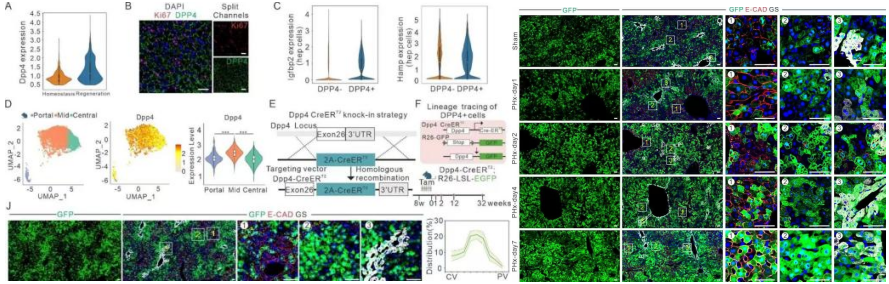
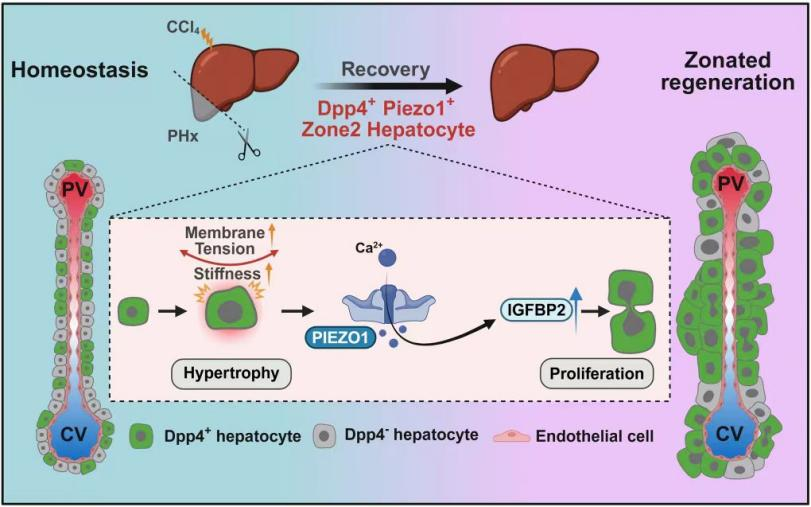
Through in-depth mining of single-cell transcriptomes, the team identified a special hepatocyte subpopulation, DPPP4+ hepatocytes, enriched in the Zone 2 region of the liver. These cells act as "sentinels," sensing increased local tissue stiffness after injury. Via the mechanosensitive ion channel Piezo1, they convert mechanical stress into bioelectrical signals, activating the downstream NFATC3-IGFBP2 signaling axis to drive liver repair and regeneration. This study establishes Zone 2 as a hub for mechanical sensing in liver regeneration. Based on this mechanism, moderate enhancement of Piezo1 signaling effectively accelerates liver regeneration, offering a novel and precise therapeutic strategy for patients with chronic liver disease and liver failure.
Paperlink:https://www.science.org/doi/10.1126/science.aef0825





 School homepage
  加入收藏
加入收藏 中文
中文