
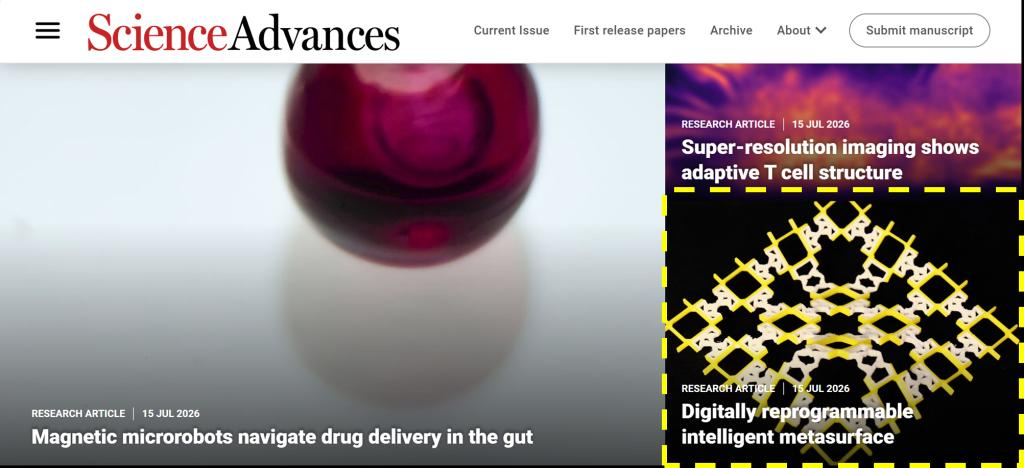
A research team led by Prof. Yilun Liu from the School of Aerospace Engineering at Xi'an Jiaotong University has proposed a systematic design method for a reprogrammable Digital-Intelligent Metasurface (DMS). By embedding "digital logic" into the mechanical behavior of physical structures and integrating machine learning to establish a deterministic mapping between digital codes and geometric morphologies, the team achieved high-fidelity, reversible reconfiguration of metamaterials between 2D planes and various self-supporting complex 3D surfaces. The results were published in Science Advances.
The study constructs bistable units with anisotropic switching characteristics. These units undergo snap-through only when force is applied in a specific direction and feature a "self-locking" function after switching. This solves the challenge of localized topography control caused by in-plane mechanical coupling in traditional multistable structures, ensuring the reconfigured morphology does not lose stability under external loads. Leveraging the bistable self-locking effect, the system discretizes the continuous deformation space into addressable digital signals. An N×N array can generate 2^(2N(N-1)) geometric morphologies; a 4×4 array stably reproduces diverse topologies including zero-curvature planes, single-curvature cylindrical surfaces, and double-curvature saddle/dome shapes.
To address the "combinatorial explosion" from the exponentially growing configuration space, the team introduced a conditional Generative Adversarial Network (cGAN) framework. This builds a nonlinear mapping between target surfaces and unit digital states, inversely resolving continuous 3D topographies into discrete binary control sequences to achieve efficient "what you see is what you get" design. Experiments and simulations show DMS exhibits state-dependent stiffness and high stability margins, actively regulating near-wall flow fields via precise surface microstructure reconstruction. This achievement provides a universal platform for "digital-intelligent mechanical metamaterials," showing great potential for morphing aircraft skins, smart flexible load-bearing components, and customized biomedical devices.
Paper link:https://www.science.org/doi/10.1126/sciadv.aef3895





 School homepage
  加入收藏
加入收藏 中文
中文