Breakthrough in Metal Anode Dendrite Growth via Mechano-Electrochemical Coupling by Professor Shen Shengping’s Team at Xi’an Jiaotong University Published in Nature Communications
A Logical Scrutiny of the Approach to Suppressing Dendrite Growth: Constructing ASEI
How to overcome the issue of uncontrolled dendrite growth in metal anodes represents one of the most fundamental bottlenecks limiting the performance leap and intrinsic safety of metal batteries. Breaking through this bottleneck is key to advancing the technological evolution of metal batteries and is also a necessary step toward the commercialization of future energy storage systems, such as all-solid-state batteries. The strategy of constructing an artificial solid electrolyte interphase (ASEI) to suppress dendrites was proposed as early as thirty years ago. However, to date, this strategy has not made a substantial contribution to the commercial application of high-performance metal batteries. The reasons are as follows: 1) The dendrite-suppression efficacy of a simple ASEI is limited; 2) The ASEI must operate over the long term under complex mechano-electrochemical coupling conditions, requiring a combination of high strength-toughness/fatigue resistance, high ionic conductivity, and chemical stability. This leads to a lack of universal design principles and criteria for synergistic multi-mechanism optimization; 3) Existing ASEI design methods rely excessively on chemical composition regulation. However, specific chemical formulations often target the enhancement of only one or a few mechanisms, and these formulations lack compatibility, making it difficult to achieve multi-mechanism synergy and performance breakthroughs through simple “formulation stacking.” In this context, when questioning “how to develop the ‘introduction of ASEI’ into a practical approach that supports the ‘commercialization of metal batteries’,” a straightforward logical puzzle arises: Is there a universal ASEI design pathway that is both highly effective and capable of integrating chemical composition regulation while synergizing mechano-electrochemical mechanisms?
Evolution of ASEI Design Pathways — Precise Optimization of Crystallographic Microstructure
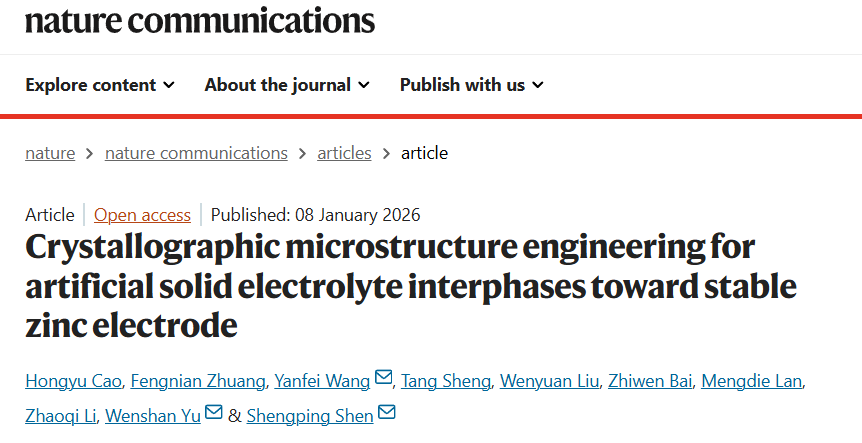
In response to the above challenges, the research group led by Professor Shen Shengping at the School of Aerospace Engineering, Xi’an Jiaotong University, has pioneered a unique approach, shifting the focus of ASEI design from traditional “chemical composition optimization” to “precise regulation of crystallographic microstructure characteristics.” The study found that single crystallographic microstructure features of the ASEI (e.g., crystal orientation, grain boundary density) exhibit critical optimal states for dendrite suppression. By orderly integrating multiple optimal microstructure features, optimal synergy of mechano-electrochemical mechanisms can be achieved within a given ASEI composition, reaching the maximum efficacy of dendrite suppression. This strategy combines high effectiveness with universality and is compatible with traditional chemical regulation strategies, opening a new pathway for constructing next-generation, high-stability, long-life metal batteries. The related research findings were published in Nature Communications under the title “Crystallographic Microstructure Engineering for Artificial Solid Electrolyte Interphases toward Stable Zinc Electrode.”
The research focuses on two core microstructural features—crystal orientation and grain boundary density—systematically revealing their regulatory effects on dendrite growth and ASEI damage mechanisms, and thoroughly analyzing the underlying mechano-electrochemical coupling mechanisms. By clarifying these structure-property relationships and using ZnS ASEI as a typical case, the optimal microstructure state for this system was successfully identified. The study found that the ZnS (111) orientation exhibits unique mechano-electrochemical synergistic advantages, combining superior mechanical strength and electrochemical kinetics, significantly enhancing the damage tolerance of the ASEI, and was thus identified as the intrinsically optimal orientation. In contrast, grain boundary density introduces a competing effect between mechanical strength and electrochemical kinetics. As grain boundary density increases, these two properties exhibit opposite trends. Electrode lifespan tests confirmed this result—lifespan showed a non-monotonic trend of “initially increasing then decreasing” with grain boundary density, peaking at approximately 55 μm/μm². This critical value represents the optimal grain boundary density that balances mechano-electrochemical performance. Based on these findings, the research team precisely integrated the optimal crystal orientation (111) and optimal grain boundary density (approximately 55 μm/μm²) into the ZnS ASEI design. The constructed ASEI effectively regulated uniform zinc ion diffusion and deposition while ensuring high damage tolerance, ultimately achieving a dendrite-free ideal anode morphology. This strategy increased the cycle life of the metal anode by 18 times, achieving stable cycling for over 3400 cycles at a high current density of 5 mA cm⁻², with an average Coulombic efficiency of 99.92%. This work breaks away from the traditional ASEI design paradigm that relies solely on chemical composition regulation, pioneering a design route based on “achieving optimal synergy of mechano-electrochemical mechanisms through precise regulation of crystallographic microstructure characteristics.” Subsequently, through systematic analysis of crystallographic microstructure design and corresponding performance optimization of ASEIs for anode systems such as Zn, Li, and Na, the universality of this design route was confirmed, providing principles and technical guidance for the development of high-stability, long-life metal batteries.
Cao Hongyu, a doctoral student at Xi’an Jiaotong University, is the first author of the paper. Zhuang Fengnian, Sheng Tang, Liu Wenyuan, Bai Zhiwen, Lan Mengdie, and Li Zhaoqi participated in the research. Professors Shen Shengping, Yu Wenshan, and Associate Professor Wang Yanfei are the corresponding authors. The School of Aerospace Engineering at Xi’an Jiaotong University and the State Key Laboratory for Strength and Vibration of Mechanical Structures under Complex Service Environments are the sole affiliations for the paper. This research was supported by grants including the Major Program of the National Natural Science Foundation of China.
Paper Link:https://www.nature.com/articles/s41467-025-68212-3





 School homepage
  加入收藏
加入收藏 中文
中文