时 间:2026年8月26日(周三)上午10:30
地 点:创新港2-4193
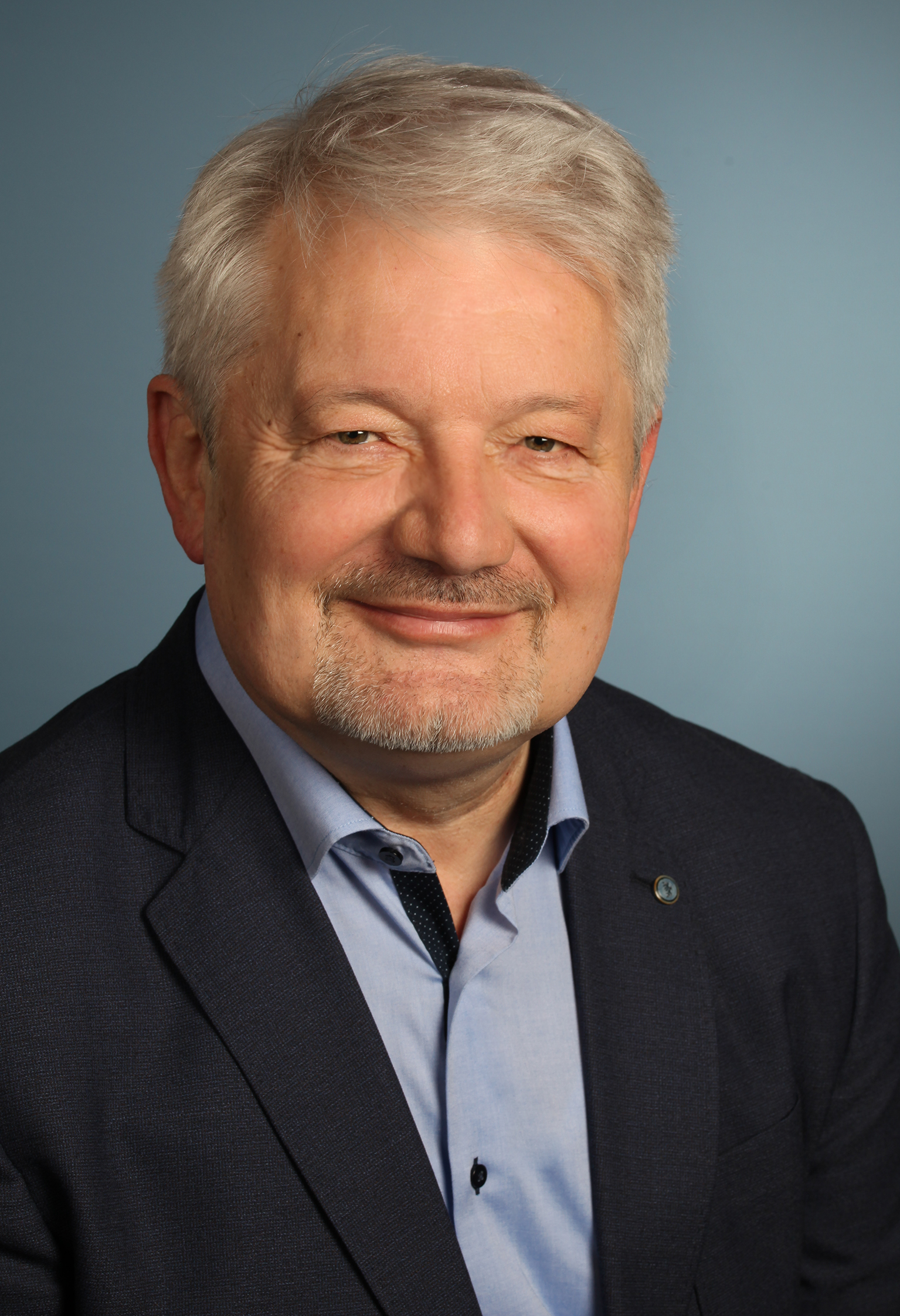
报告人:J. Schröder
报告人简介:
Jörg Schröder,德国杜伊斯堡-埃森大学教授,德国工程院院士,美因茨科学与文学院院士,国际计算力学协会会士,欧洲力学学会会士,克罗地亚力学学会荣誉会员,Archive of Applied Mechanics期刊主编,曾任德国应用数学与力学学会(GAMM)主席。主要从事计算力学、连续介质力学、本构建模及多尺度计算方法研究,30年来持续开展基于FE²方法的直接多尺度建模研究。近年来重点关注电-磁-力多物理场耦合、基于统计相似代表性体积单元法的微结构建模、微磁系统尺度转换及广义连续介质多尺度建模等问题。此外,在超弹性材料多凸性计算、本构理论、混合有限元方法,以及纤维增强先进混凝土的本构描述与相场正则化等方面开展了系统研究。发表学术论文300余篇,出版学术著作15部。
Introduction of the Lecturer:
Jörg Schröder is a Professor of Mechanics and was twice Vice-Rector for Research at the University of Duisburg-Essen. From 2020 to 2023, he served as president of the International Association of Applied Mathematics and Mechanics (GAMM), followed by a term as vice president until 2025. He is a member of the Academy of Sciences and Literature Mainz and the German Academy of Science and Engineering "acatech". Notably, he served as the spokesperson for the DFG Research Unit 1509, "Functional Materials at Multiple Scales, Continuum Modeling and Experimental Characterization." He also led the DFG Priority Program 1748, "Reliable Simulation Techniques in Solid Mechanics." Between 2017 and 2025, he served on the Senate of the German Research Foundation (DFG); since 2017, he is member of the DFG Committee for the Investigation of Allegations of Scientific Misconduct. His commitment to research evaluation extends to serving on the selection committee for the Alexander von Humboldt Foundation's research fellowships from 2016 to 2026. Since May 2024, he has been managing the DAAD project "Establishment of the Degree Program Computer Simulation in Science and Engineering at Bethlehem University," which involves Bethlehem University, the Technical University of Darmstadt, and Friedrich-Alexander University of Erlangen–Nuremberg. He received the Fellows Award of the International Association of Computational Mechanics (IACM) in 2022. Additionally, he was awarded honorary membership in the Croatian Society of Mechanics and received the European Mechanics Society's Fellow Award in 2025.
His research interests include computational and continuum mechanics as well as constitutive modeling. For three decades, he has focused on direct methods in multiscale modeling (FE²). His recent work addresses electromagnetic–mechanical coupling and the development of simplified microstructural models based on statistically similar RVEs. He analyzes scale transitions of micromagnetic systems and generalized continua with attached classical microstructures. Further research projects concern the computational treatment of polyconvexity in hyperelasticity and the development of mixed finite element formulations. He also studies phenomenological descriptions of fiber-reinforced modern concretes and their regularization using the phase-field method. He has co-authored more than 300 scientific publications and 15 books. He serves as Editor-in-Chief of the Archive of Applied Mechanics and is a member of the editorial boards of several international journals.
报告题目:磁-电-力耦合问题:基于FE² 方法的算法跨尺度建模
Title: Magnetic-electrical-mechanical coupled problems:Algorithmic scale-bridging with the FE2-method
内容简介:
同时具有两种或多种铁性特征的材料被称为多铁性材料,其内部可产生电场与磁场间的相互作用。这种磁电耦合效应可应用于传感技术、电场调控磁数据存储器件等领域。大多数单相磁电材料中的电极化与磁化耦合仅发生在远低于室温的环境下,超出了实际工程中的温度区间。因此,制备由铁电基体和磁致伸缩夹杂组成的两相复合材料尤为重要。此类材料依靠组分间的相互作用,能够在室温条件下产生磁电耦合效应。我们将磁电效应分为正磁电效应与逆磁电效应:正磁电效应指磁场诱导产生极化,外加磁场会使磁活性相发生变形,该变形进一步传递至电活性相;逆磁电效应则是由电场激励产生磁化。因此,复合材料的磁电耦合性能,显著依赖于两相材料各自的本构行为,同时也和复合材料的微结构形貌密切相关。
本工作针对同时具备电活性与磁活性的微非均质复合材料开展建模研究;该类材料可以通过耦合衍生出等效宏观磁电耦合特性。为求解材料等效性能,研究采用被称为FE²方法的均匀化方案,通过跨尺度分析将宏观尺度与微观尺度进行耦合。为复现真实的耦合响应,我们在微观尺度为各组分建立适配的材料本构模型,用以刻画材料典型的磁滞回线。
Abstract:
Materials which combine two or more ferroic characteristics are known as multiferroics and can exhibit an interaction between electric and magnetic fields. This magneto-electric (ME) coupling can find applications in sensor technology or in electric field-controlled magnetic data storage devices. Since most ME single-phase materials show an interaction between electric polarization and magnetization far below room temperature and therefore outside of a technical relevant temperature range, the manufacturing of two-phase composites, consisting of a ferroelectric matrix with magnetostrictive inclusions, becomes important. They generate the ME coupling at room temperature as a result of the interaction of their constituents. We distinguish between the direct and converse ME effect, whereas the direct effect characterizes magnetically induced polarization, where an applied magnetic field yields a deformation of the magneto-active phase which is transferred to the electric phase. Furthermore, the converse effect characterizes electrically activated magnetization. Hence, the ME coupling of composite materials significantly depends on the material behavior of both phases as well as on the morphology of the composite's microstructure. In this contribution we discuss the modeling of micro-heterogeneous composites with electrically and magnetically active phases, which exhibit as a product property an effective (macroscopic) magneto-electric coupling. In order to determine the effective properties a homogenization approach, the so-called FE²-method, is performed, which combines via a scale bridging the macro- and microscopic level. In order to predict a realistic coupling behavior we implemented suitable material models on the microscopic level for the individual phases to depict the characteristic hysteresis loops.
参考阅读:详见附件
Please find attached the reference reading material related to the upcoming report if needed.





 学校首页
学校首页 加入收藏
加入收藏 English