From August 24 to 28, 2026, the "2026 Gas-Kinetic Scheme Workshop" was held at Xi'an Jiaotong University's Innovation Harbor to promote theoretical innovation, algorithmic practice, and interdisciplinary applications of gas-kinetic schemes. Hosted by the Fluid Mechanics Committee of the Chinese Society of Theoretical and Applied Mechanics and co-organized by the School Of Aerospace Engineering of Xi'an Jiaotong University, Beijing Normal University's School of Mathematical Sciences, the HKUST Shenzhen Research Institute, the State Key Laboratory for Strength and Lifetime of Major Equipment Structures in Complex Service Environments, and the Shaanxi Key Laboratory of Advanced Flight Vehicle Service Environment and Control, it gathered experts, scholars, young researchers, and students from universities, research institutes, and enterprises. Focusing on basic algorithms, open-source programs, and latest advances, it arranged 10 academic reports on finite volume methods and kinetic scheme fundamentals, high-order scheme construction and programming, turbulence modeling, the Unified Gas-Kinetic Scheme (UGKS), multi-scale phonon transport and plasma algorithms, and high-performance computing applications, plus an opening ceremony, flash talks, and discussions.
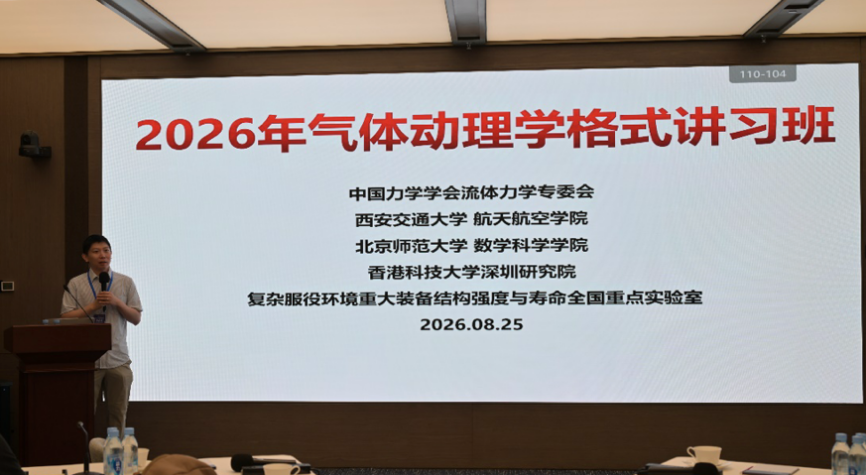
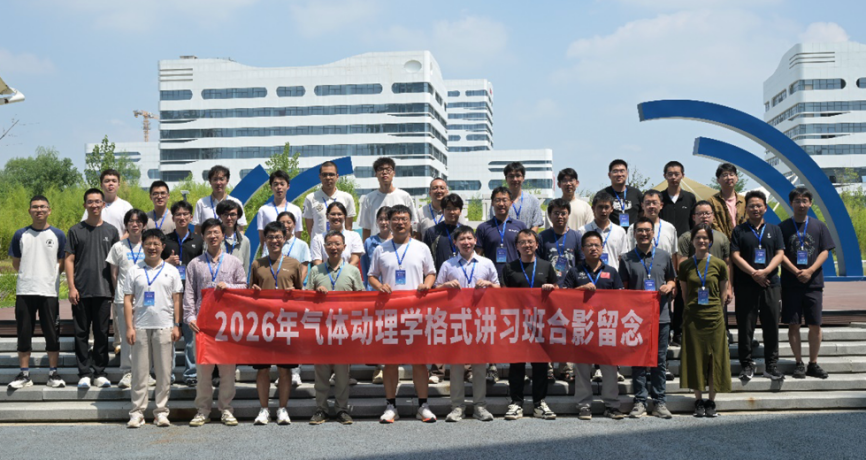
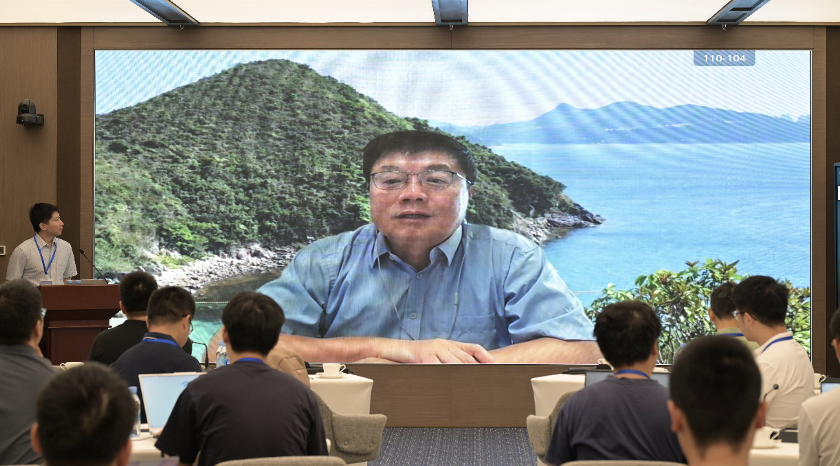
At the opening ceremony on August 25, Professor Xu Kun, Vice President of the Chinese Society of Theoretical and Applied Mechanics and from the HKUST Shenzhen Research Institute, delivered an online address, welcoming participants and noting new opportunities and challenges in computational fluid dynamics regarding algorithm innovation and independent software development; he encouraged combining lectures with hands-on programming to consolidate theory, master methods, and broaden horizons. Professor Ji Xing of Xi'an Jiaotong University and Associate Professor Pan Liang of Beijing Normal University then lectured on "Fundamentals of Gas-Kinetic Schemes and Programming Practice" and "High-Order Gas-Kinetic Schemes and Programming Practice," covering finite volume methods, gas-kinetic theory, second- and high-order gas-kinetic schemes, and programming practices. On August 26, Associate Professor Li Qibing of Tsinghua University introduced gas-kinetic turbulence modeling and simulation; Dr. Yang Xiaojian of the HKUST Shenzhen Research Institute presented wave-particle turbulence simulation; and Dr. Zhang Yue of the same institute explained the UGKS's basic theory, algorithm construction, compatibility analysis, and large-scale parallel implementation. On August 27, Associate Professor Zhuo Congshan of Northwestern Polytechnical University introduced simulations of high-speed rarefied incoming flow and jet interaction; Associate Researcher Li Shiyi of the Beijing Institute of Applied Physics and Computational Mathematics reported an efficient space-time high-order gas-kinetic scheme for the Euler equations; Researcher Zhang Chuang of Zhejiang University introduced an efficient multi-scale algorithm for the phonon Boltzmann transport equation; Dr. Pu Zhigang of the HKUST Shenzhen Research Institute introduced a multi-scale plasma algorithm based on gas-kinetic schemes; and Mr. Pei Weicheng of Huawei introduced the Kunpeng platform's practice in fluid mechanics research innovation.
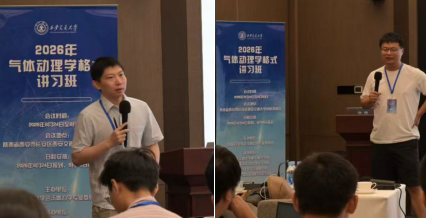
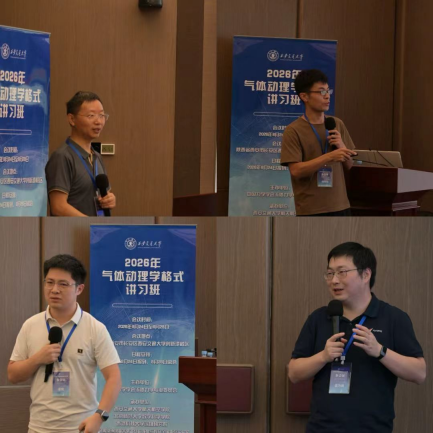
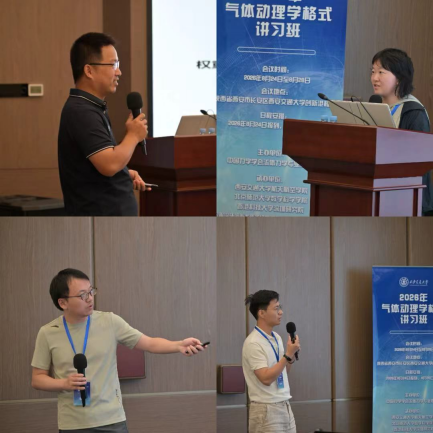
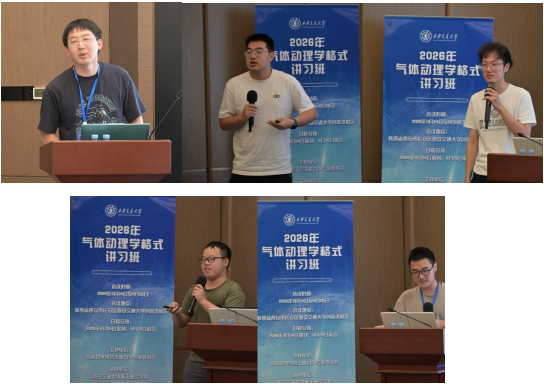
The workshop also featured flash talks and discussion sessions, where participants exchanged deeply with lecturers on multi-scale algorithm construction, program implementation, and application scenarios, and young participants presented their ongoing projects. The event concluded with Professor Ji Xing announcing the official close of the 2026 Gas-Kinetic Scheme Workshop.





 School homepage
 加入收藏
 中文